Why a limited edition?
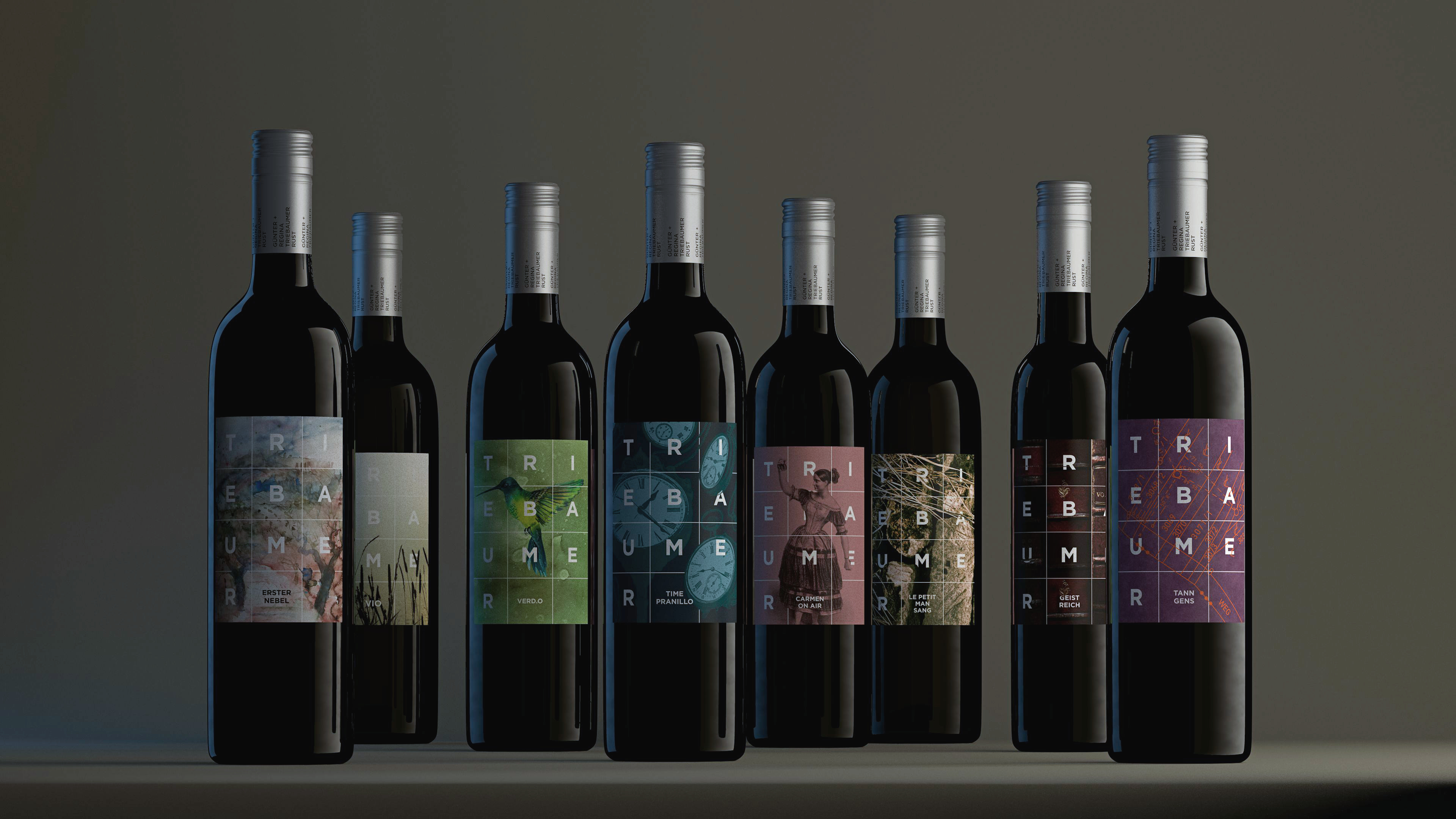
For decades now – yes, it really is a long story – we have been working with internationally renowned varieties.
As we always say: If people had had better means of transportation during the post-phylloxera recovery phase, they would probably have cultivated other varieties alongside Sauvignon Blanc, Chardonnay, Merlot, Cabernet Franc and Cabernet Sauvignon.
We’ve simply set the record straight over the last 40 years.
As it says in our blog article ‘25 Years of the Wide World – a mad travelogue’ (the mother of all experiments): For the Triebaumers, the fork in the road between ‘trying things out’ and ‘let’s see’ is a very asymmetrical one, comparable to a multi-lane motorway and a service road. Experimentation only becomes interesting – truly interesting, in fact – when regular quantities of wine are bottled as single-varietal wines.
The Phytosanitary Act was never the problem for us – in this age of globalisation, it has become irrelevant anyway.
Since 2024, we have been working with the Federal Office for Viticulture in Eisenstadt on the ‘legalisation’ – that is, recognition as quality wines – for the varieties Viognier, Petit Manseng, Carménère, Nebbiolo, Tannat, Tempranillo, Malbec and Petit Verdot.
Following numerous measurements of the ageing process and analyses of young wines, a position paper will eventually be drawn up (at a snail’s pace) stating that these varieties tolerate the August heat better than many local ones. Particularly valuable for our mindset is the fact that we are consulted by colleagues and the trade press on matters relating to Blaufränkisch, Furmint and Botrytis/Ruster Ausbruch, as well as on the subject of international grape varieties. We’re proud of that!
NEBBIOLO
It all began at the Triebaumer Christmas party in 1986. Back then, we tasted the Barolos and Barbarescos from the 1982 vintage – one of the finest vintages ever – which had just come onto the market. We were, as one might say today, quite blown away. The reaction was clear: we had to try something like that here too.
No sooner said than done. In the spring of 1987, a small delegation from the family travelled to Piedmont. There, Paul and Ernst met, amongst others, Elio Altare, ‘il Professore’ from La Morra. They hit it off straight away, and thankfully he gave his visitors 300 Nebbiolo cuttings from his favourite selection.
They were planted in our top vineyard, Plachen, on weathered slate with a layer of loam. Since 1994, we have held a special licence from the province of Burgenland for ‘Erster Nebel’.
It is this soil that gives the Erster Nebel its unusually dark colour for a Nebbiolo. The clay prolongs the growing season, intensifies the fruit and consistently produces the characteristic violet sheen. At the same time, it gives rise to that enchantingly cool fruitiness that has always characterised the wine.
During ageing, we deliberately avoid using new oak. The comparatively short barrel ageing period of twelve months also serves the same purpose: to bring out the plum-like flavour – but not the harshness – and the cool, concentrated fruit as authentically as possible.
Nebbiolo is not very widespread outside its homeland. It is found in Piedmont, where it forms the basis for Barolo and Barbaresco, in Valtellina, in the Aosta Valley – and indeed in Rust. By now, one can certainly speak of old vines when it comes to the ‘Erster Nebel’. And the fact that the experiment has paid off is demonstrated not least by the first vintage of 1990, which can still be enjoyed today – provided you still have a bottle left.
VERD.o
We’ve been growing Petit Verdot in the upper Ried Gemärk since 1999. The variety originally comes from Laimburg in South Tyrol. Josef Terleth, who was head of research and head of viticulture at the time, supplied us with Petit Verdot as well as Tannat and Lagrein. Shortly afterwards, we visited Elisabetta Foradori, and we’ve been growing Teroldego ever since. That’s how some things come about.
Petit Verdot ripens very late indeed – around three weeks after Cabernet Franc. That’s why the wine is called VERD.o – the little green one. Every year, the question arises anew: will it ripen? The answer is: yes. But you have to be patient. And cover the vines. And wait a little longer still.
Our first attempt at a single-varietal wine came about with the addition of a few kilos of grapes from a colleague and friend. Since the 2020 vintage, we’ve been vinifying it separately. Open-tank fermentation, 300-litre barrels that have been used several times. Quite grippy, but also very typical.
Compared to Carménère, Petit Verdot offers a completely different tannin structure, significantly more acidity and, overall, more bite. As the vines age and in light of climate change, this variety is becoming increasingly interesting to us. What was long considered an exotic variety could yet become quite relevant.
GEISTREICH
We’ve had Geistreich before – in 2006, 2007, 2008 and 2009. Now it’s back. The tax and customs issues have been sorted out, and all the relevant authorities are satisfied – so nothing stands in the way of a new release.
The base wine is ‘Weite Welt’. Fortification makes it even more concentrated. We don’t want an oxidative style, but rather the exact opposite: dense, dark, powerful and full of fruit. A real chocolate lover’s delight, in fact.
Geistreich is made according to the classic port wine method. The must ferments normally at first, is then racked off at around 7.5% alcohol and 10% of the total juice volume, and fortified with alcohol. Afterwards, everything is recombined. It sounds simple, but the challenge lies in ensuring that the fruit, colour, alcohol and sweetness ultimately come together to form a harmonious whole.
It is deliberately bottled young. We don’t want oxidation; we want fruit. Dark berries, chocolate, power and depth. Deeply dark, profound, far-reaching and highly aromatic. Stylistically, it is perhaps most akin to a young vintage port – though significantly less tannic and entirely focused on the fruit.
The result is a fortified wine that is both opulent and surprisingly approachable. That is exactly what Geistreich is meant to be.
CARMEN on AIR
The story of our Carménère begins with a trip to South America at the turn of the millennium. The vines were brought back immediately after the harvest, grafted and propagated at home by Paul Triebaumer, and finally planted in the magnificent Upper Mitterkräftn region in Rust. Since then, the variety has delighted us year after year with beautiful grapes.
However, Carménère developed somewhat differently than expected. The variety did not prove to be the ‘sugar-laden’ wine it is often thought to be. That is why we deliberately avoid new oak, work with used barriques and bottle comparatively early. The fruit should take centre stage.
The 2023 vintage was exceptional in many respects. It produced the mildest red wine we have ever made. It was clear from the very first tastings: this one needs to be bottled young. Violets, dark blossoms, blackberry sweets – incredibly floral and open-hearted. Almost a bit like a Beaujolais, or a caricature of a Cabernet Franc.
The astonishing thing is this: despite its lightness, the wine has an alcohol content of around 14% by volume. It seems light on its feet, but is anything but lightweight. It is precisely this combination that makes Carmen on Air so unique.
LE PETIT MAN SANG
Why Petit Manseng?
The explanation is actually quite simple. Two wines drew our attention to this grape variety: a Petit Manseng ice wine from the Scheiblhofer vine nursery and a single-varietal Château Montus Blanc. Both have impressively demonstrated what this variety is capable of.
Petit Manseng possesses a number of characteristics that are highly interesting today. The berries are small, thick-skinned and loosely clustered, making them virtually immune to botrytis. At the same time, the variety ripens even later than Welschriesling or Furmint. In Rust, we usually harvest it around three weeks after Cabernet Franc.
Added to this is an exceptional acidity potential combined with the highest level of physiological ripeness – and all without irrigation, as is generally the case here in Rust. That is why, for years, we have preferred to replant lost vines with Petit Manseng. With these characteristics, the variety can’t really go wrong anywhere.
Whilst Petit Manseng is now authorised in Bordeaux and is being trialled in several European wine regions, it still lacks recognition as a quality grape variety in Austria. That is why, with a little French-style play on words, the name ‘Le Petit Man Sang’ – ‘the little man sang’ – was coined.
In 2019, the opportunity arose to take over grapes from an existing vineyard in Rust. We didn’t have to think twice. After all, we at Triebaumer have always been pioneers when it comes to grape varieties.
The 2021 vintage yielded only a tiny amount. The fermentation simply refused to progress any further. The result is a wine unlike anything we’ve seen in Austria before: fully ripe grapes, tremendous intensity, plenty of acidity and a spectrum of aromas ranging from peach nectar to pickled nuts. It quickly became clear that Le Petit Man Sang would remain a permanent fixture in our limited-edition range.
The first dry wine followed in 2022. Since 2026, we’ve been harvesting from our own 0.33 ha plot on the Gillesberg.
Petit Manseng – small, late-ripening and packed with character
The berries are tiny – about half the size of a small fingernail. Lots of skin, usually two seeds and just a little juice. That’s exactly what makes Petit Manseng so exciting: maximum concentration in the smallest of spaces.
The variety ripens extremely late. At harvest time, the leaves and berries are often still a rich green – almost as green as our Verdo label – and yet Petit Manseng easily reaches around 23 °KMW.
The variety is native to south-western France, where it has been prized for centuries for producing great sweet wines and characterful white wines.
We originally purchased Petit Manseng to replenish our stock. Even back then, Günter was convinced that the variety lived up to its reputation: exceptional aromas, lively acidity and enormous ageing potential.
One row was also grafted with scions from the St. Georgen vine supplied by Hans Moser – simply because we want to preserve this unique Austrian grape variety in our vineyard too.
And here’s another special feature: pure slate slopes are a real rarity in northern Burgenland. That is precisely why we are interested in how Petit Manseng develops its very own character on this soil.
TANNGENS
tan = opposite side / adjacent side
All clear?
Trigonometry has three formulas for measuring distance and length: sine, cosine and tangent. All of this is used in cadastral surveying. And that is precisely where the story of our first single-varietal Tannat begins.
As already mentioned in the Gillesberg post (see blog), our highest vineyard site features an 18th-century survey marker, a boundary marker and another, very precisely hewn stone from the early 20th century. The history of the site is therefore closely linked to surveying and geometry.
When it came to naming our first single-varietal Tannat, we initially came up with a whole collection of suggestions, some of them rather odd. The problem was that, for ‘wine from Austria’, the grape variety cannot be named. At the same time, we are campaigning for this rule to be changed in future for several internationally renowned varieties.
The final solution then came completely out of the blue. As we were already standing in the hall getting dressed to leave, Ella, our second-born, suddenly said: ‘Tangens!’ It had just been the topic in her maths lesson in her third year at economics school.
And that was it.
Once again, innovation and history came together in perfect harmony. The ‘Tanngens’ was born. What was particularly lovely was that we later even found a sketch of the vineyard in old documents, showing the trigonometric points and plot boundaries. One could hardly have imagined a better story.