Dry stone walls in Rust – here’s to another 500 years!
When the “sweet wine miracle” of Botrytis cinerea was “discovered” in Rust and Tokaj more than 500 years ago, the value of suitable vineyard land increased enormously.
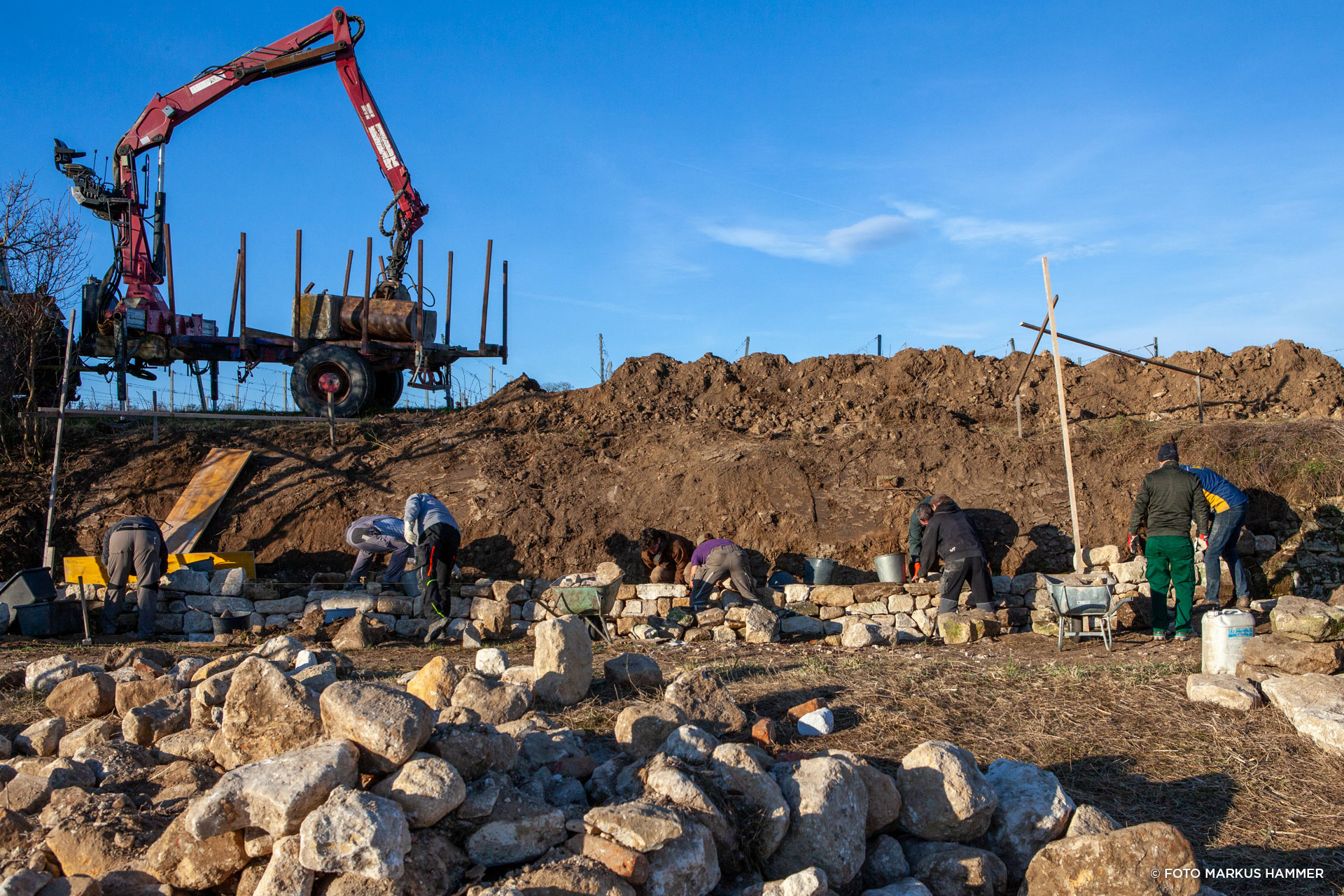
Without knowing the term “erosion,” there was a clear understanding: “We must keep the soil on the slope!” Thus began a long, arduous process, at the end of which most of Rust’s southern slope and parts of the northern slope were divided into five large terraces.
With our Gillesberg single vineyard as the sixth terrace at the very top.
As a final reinforcement for each level, countless hardworking hands built dry stone walls, some varying in height from 1.5 to 2.5 meters. An exhausting undertaking demanding the utmost precision, these walls—constructed according to ancient agricultural techniques—consist exclusively of local limestone and the unique, locally sourced Ruster gravel (i.e., slate), without any iron, concrete, or mortar, simply leaning against the ground level at the correct thickness and specific angle.

Over time, the construction and renovation of walls became so commonplace that it was not even mentioned in the extensive Ruster city archives, even though it certainly represented a significant expense.
This was accompanied by a certain hierarchy of value. The two lower terraces were already appreciated (due to Botrytis) because of the increased mist and humidity and their proximity to the lake and reeds, but they were not as highly sought after, as the starlings nesting in the reeds had always been mortal enemies.
The top tier was also not highly sought after, because the ever-present wind snapped many shoots there, making it seem unsuitable for the native varieties Furmint and Blaufränkisch with their variety-specific, vigorous growth.
The middle of the slope, on the other hand, was the most valuable—just like in Burgundy—and back then, one could even compete with Burgundy in terms of price!
Thus, these most defining of all landscape elements persisted until the approaching end of World War II. Under forced labor, the “Reichsschutzstellung” (Reich defense line) à la “Ostwall” was constructed from Pressburg to southeastern Styria.
The so-called “Fortification Line B” also incorporated the venerable dry-stone walls of Rust. In a completely nonsensical move, tank trenches were dug right in front of these walls.
The Red Army simply drove right past them.
Even before the war ended, the walls—now deprived of their immense stability—partially slid into the worthless trenches. And with every thunderstorm, the situation worsened.
Then came ten long years of Soviet occupation. Many men skilled in wall-building were dead or in Siberia. Consequently, the know-how disappeared completely.
The first tractor owners in the 1950s and 1960s even appreciated being able to drive up the now-sloping embankments into the vineyards. Of the original approximately 10 kilometers of walls, only a few hundred meters survived in fragments.
It wasn’t until 2023 that, on the initiative of the extremely history-minded Günter Triebaumer, the group “Mauerbauer” (wall builders) was established, initially on a private basis and self-financed.
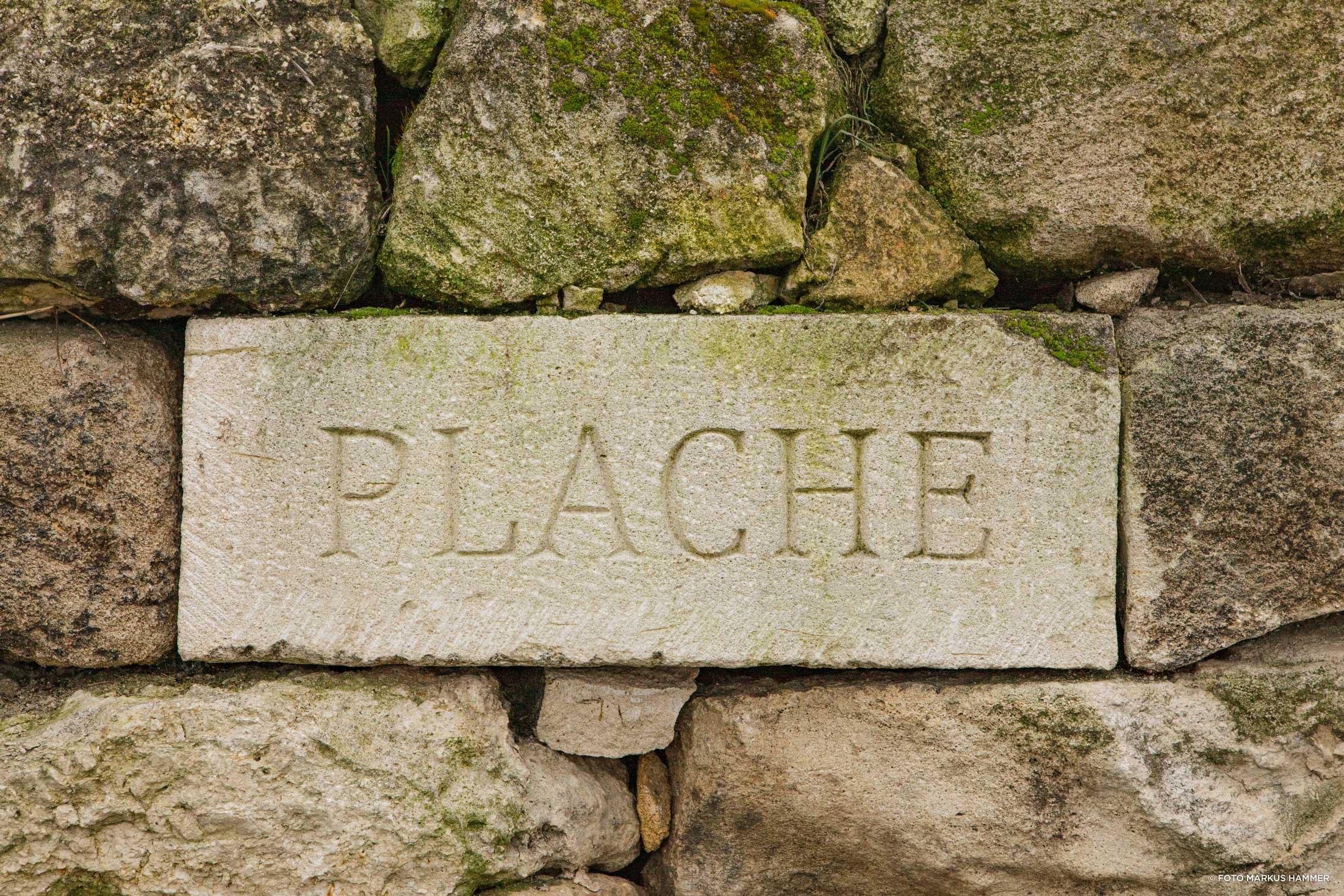
At the foot of the legendary Ried Plachen, adjacent to the Ried Turner, twelve enthusiasts, under the guidance of Prof. Mag. Rainer Vogler and DI Michael Dobrovits from the Austrian Dry Stone Walling School, connected two remaining sections. In 2025, during a cold and wet week in February, the second phase took place at the same location.
To be continued!
Günter Triebaumer is still in charge of the overall organization, but the powerful Rust Winegrowers’ Association now serves as the sponsoring organization.
Due to its high ecological value and for regional tourism reasons, the second subproject received state funding. Local people are building highly durable structures using local materials—historically authentic and completely free of chemical residues.
Visitors are welcome to explore the Turner-/Plachenweg to experience history brought back to life.
©Photos Markus Hammer