25 Years of ‘Weite Welt’ – a zany travelogue
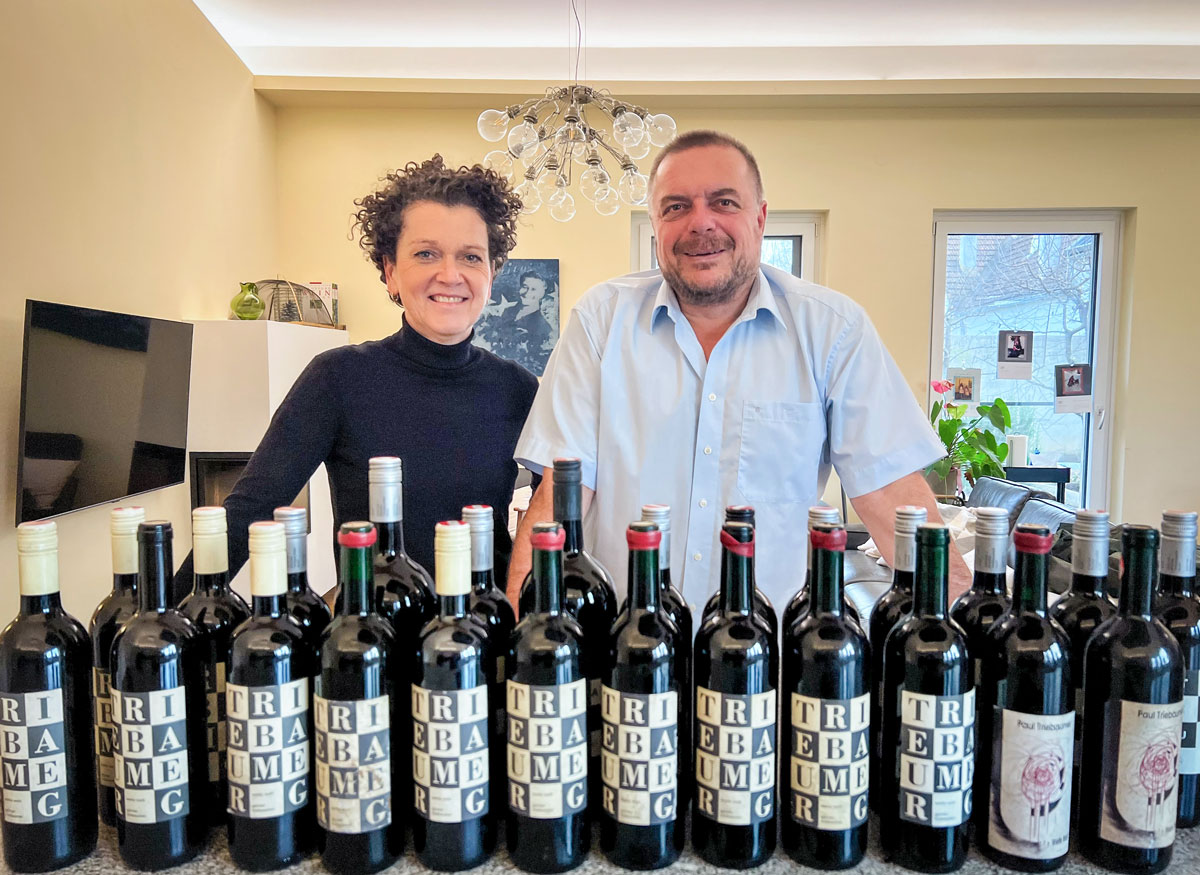
It was back in the 1990s, when many winegrowers were getting to grips with the so-called ‘international grape varieties’.
The Triebaumers were relative latecomers to the Cabernet-Merlot complex – but were practically always the first when it came to all the ‘others’.
Although Cabernet Sauvignon, Cabernet Franc and Merlot were already being offered by the Johannes Rebschule in Ödenburg as early as 1894/95 – we even have an original price list to prove it – it took a further 90 vintages or so after the phylloxera eradication programme before the Bordeaux varieties won over producers and consumers alike.
The devastating wave of Phylloxera vastatrix originated in the Gironde and Garonne regions of continental Europe and thus took around twenty years to wreak its havoc in the Burgenland region.
And the European wine-growing world modelled its recovery efforts – including the choice of grape varieties – on Bordeaux.
Speculatively speaking: had people back then had the logistical capabilities we have today, perhaps a Syrah from the Rhône, a Nebbiolo from Piedmont or even a Tempranillo from the Iberian Peninsula might have come to the fore sooner.
As it was, however, the ‘usual suspects’ took centre stage – in Hungary, Romania, Bulgaria, northern Italy, etc.
For the Triebaumers, the crossroads between ‘giving it a go’ and ‘let’s see’ is a very asymmetrical one, comparable to a multi-lane motorway and a narrow footpath.
And so it came to pass that, prompted by a tasting of Barolo and Barbaresco at the 1986 Christmas party, they decided to explore the subject of Nebbiolo in greater depth. No sooner said than done! Incidentally, there will be a separate blog post about this story.
In 1990, Günter Triebaumer was awarded a travel grant by the Burgenland Wine Academy to visit South Africa. Immediately, a cross-generational consensus was reached: Syrah/Shiraz would be brought back from there.
Completely disregarding the strict phytosanitary laws, the plan was skilfully put into action. The grafted cuttings brought back were immediately grafted using the tongue-cut method onto a vineyard of the original Frühroter Veltliner variety – which was already 35 years old at the time – in the small village of Eden, and sealed with liquid paraffin from a fondue pot repurposed for the task.
The 95 per cent survival rate remains legendary and unrivalled to this day. A few Pinotage vines proved to be the icing on the cake and a welcome addition. Following the first Syrah harvest in 1993, an application was made for a special licence for Syrah and Nebbiolo. The Chamber of Agriculture responsible rejected the application three times without giving any reasons.
Paul Triebaumer therefore wrote a letter to Paul Rittsteuer, then Regional Minister for Agriculture, asking which he preferred: farmers who experimented with internationally renowned varieties at their own risk, or those who took turns protesting against frost, drought or excessive taxation. Permission was granted.
The implementing authority in Department 4A of the Burgenland Provincial Government then had a ‘clerk’ ring up to ask whether Nebbiolo was a ‘red’ or a ‘white’ wine. One might well think of the all too rare white Barolos!
This, however, was the final straw that broke the camel’s back when it came to civic restraint.
In 1994, Günter Triebaumer sent ten faxes to the most interestingly described Rioja estates featured in the Slow Food World Wine Guide.
The request? A plea for Tempranillo vine cuttings. Incredibly, four consignments of the coveted material actually arrived!
In the same year, Cabernet Sauvignon, Cabernet Franc and Merlot were planted in the Kraxner vineyard in Rust, on the fourth altitude level, on weathered slate at Tegel, covering 0.9 hectares, 13 rows, with three bends – in other words, an old wine-growing area.
The experienced vine propagator Paul Triebaumer produced all the planting vines himself and, as it later transpired, evidently had access to excellent grafting scions.
He also tried every possible rootstock, although, looking back over the years, the good old Kober 5 BB has proved to be the best.
Every variety on every rootstock – all neatly documented on a flattened former shoe box – the famous ‘Eternal Plan’!
The year 1997 then brought the first harvest: Moderate weather conditions, perfect harvesting weather – a joy. After vinification, satisfaction set in once more, as the young wine showed great promise.
Then, little by little, the question arose: ‘What shall we call it?’
Günter Triebaumer had studied Latin for a few years at school; French names were very much in vogue, and the flood of Anglicisms was just beginning to roll in.
At first, ‘Viribus unitis’ emerged as the favourite. Well. An old Austrian battleship that hadn’t existed for quite some time. Besides, the name was already taken. At this point, warmest regards to Josef Terleth, Norbert Kofler and Andi Sölva – three proper South Tyrolean lads!
It was precisely these three friends, who work at the Laimburg Research Institute and Provincial Winery, who helped us discover Lagrein, Petit Verdot and Tannat. Ultimately, the choice fell on the simple but self-explanatory ‘Weite Welt’. And that’s how it remains to this day.
The following year saw the addition of Teroldego, as a nod, so to speak, to Elisabetta Foradori on the Rofiliano high plateau in Trentino.
A year later, there was a trip to South America, by which time Regina had long since joined the group. The souvenir: Carménère!
The Zinfandel vines at Ridge Mountain proved to be too optimistic and were grubbed up eleven years after planting due to institutional immaturity.
To explain the growth and flavour characteristics of the individual varieties in detail would go beyond the scope of this essay and will be covered in a subsequent piece.
To summarise briefly: ‘Die Weite Welt’ is a Cabernet blend with Syrah and a touch of Merlot, as well as six to seven ‘supplementary varieties’ depending on the vintage and special releases. Dark, dense, firmly structured and consequently long-lasting, as well as being quite successful to boot. Unique in the world!